
Shopping Guide
Welcome to Wa no Kaori. We are a Japanese incense shop based in Kyoto, and we ship worldwide directly from Japan. This guide explains how our shop works, how to find a scent you will like among our range, and what to expect after you place an order. If you are looking for a specific answer to a specific problem, our FAQ goes into more detail, and you are always welcome to email us at info@wa-no-kaori-incense.com.
Contents
Before you order
Choosing your incense
- 4. Start with three questions
- 5. Scent families
- 6. From light to rich
- 7. Forms and burning times
- 8. Not sure where to start? Try a sampler
How to order
After your order
- 10. Tracking your parcel
- 11. Changes, cancellations and refunds
- 12. If customs charges you
- 13. If an item is discontinued
Using your incense
Other
1. In-stock and sourced items
We hold a large part of our range in our own stock in Japan. The rest we source from the maker after your order is placed. Many of the workshops we work with are small and produce in small batches, so keeping every one of our items in stock at all times is not possible.
Every product page tells you which is which, just above the add to cart button:
- Ships within 2 days means the item is in our own stock.
- Ships in 10 days or Ships in 14 days means we source it from the maker for you after your order.
In-stock orders are dispatched within 2 business days of your order date. If your order contains sourced items, we prepare the whole order together and send it as one parcel once every item has arrived with us, so the longest dispatch time in your order applies to the order as a whole.
If an item takes longer than we expected, we will email you and let you know where things stand.
2. Duties and taxes
United States. Import duties are already included in the price you pay. There is nothing further to pay when your parcel is delivered.
Everywhere else. Our prices do not include import charges. Depending on the rules of your country, your customs authority may charge import duty and sales tax such as VAT or GST, and the postal service or courier may add a handling fee of its own. These charges are collected from you on or after delivery by the carrier or by your customs authority, not by us. The amount is decided by your country, so we are not able to tell you in advance what it will be. If you want to know before you order, your national customs authority is the right place to ask.
A note for customers in Canada. The duty free allowance for postal shipments into Canada is very low, and the postal service adds a fixed handling fee on top of the tax. Even a small order can therefore attract charges. We mention this not to discourage you but so that the invoice is not a surprise.
We declare the full value of every parcel, as we are required to do. We are not able to mark an order as a gift or to declare a lower value than you paid.
3. Shipping options and how long it takes
You can choose between two options at checkout, and both are tracked.
- Standard Shipping is sent with Japan Post.
- Express Shipping is faster and is sent with FedEx, or with Japan Post EMS for orders to the United States.
Shipping fees and the options available for your country are shown at checkout, and are listed in full on our Shipping Information page.
As a guide, Standard Shipping usually takes the following, counted from the day you order:
- Australia and New Zealand: 1 to 2 weeks
- Canada, Mexico, Europe, the Middle East, China, Hong Kong, Taiwan and Korea: 1 to 3 weeks
- United States, Italy and Southeast Asia: 2 to 4 weeks
Express Shipping usually takes 3 to 7 days, and 5 to 10 days for the United States.
About tracking, honestly. Standard Shipping is tracked, but the quality of the tracking changes once your parcel leaves Japan and is handed over to the postal service in your country. Some countries report every step, and others report almost nothing until the parcel is delivered. For a small number of destinations, in particular Singapore, Malaysia and Vietnam, delivery data is not sent back to Japan at all, so the tracking page can stop updating even though your parcel is moving normally. If your tracking has not changed for a while and you are worried, please contact us. We can ask Japan Post directly.
4. Start with three questions
We carry more than 3,500 items, and the names alone will not tell you much if Japanese incense is new to you. Three questions will get you close.
How strong do you want the scent to be? Japanese incense is generally quieter than Indian or Tibetan incense. Within our range, floral and daily blends stay in the background, while agarwood and kyara are deeper and stay in the room for longer.
How much smoke are you comfortable with? A traditional stick produces visible smoke. If you burn incense in a small room, in an apartment, or near someone who is sensitive, look for items described as low smoke, and consider shorter sticks or breaking a stick in half.
Where and when will you burn it? A short stick at a desk, a coil for a long quiet evening, and a warmed kneaded incense for a slow ritual are three different experiences. Section 7 explains the forms.
5. Scent families
We group our range by scent so that you can move through it quickly. Our product descriptions use these words consistently, so once you know which family suits you, the wording on a product page will tell you whether it is close to what you already like.
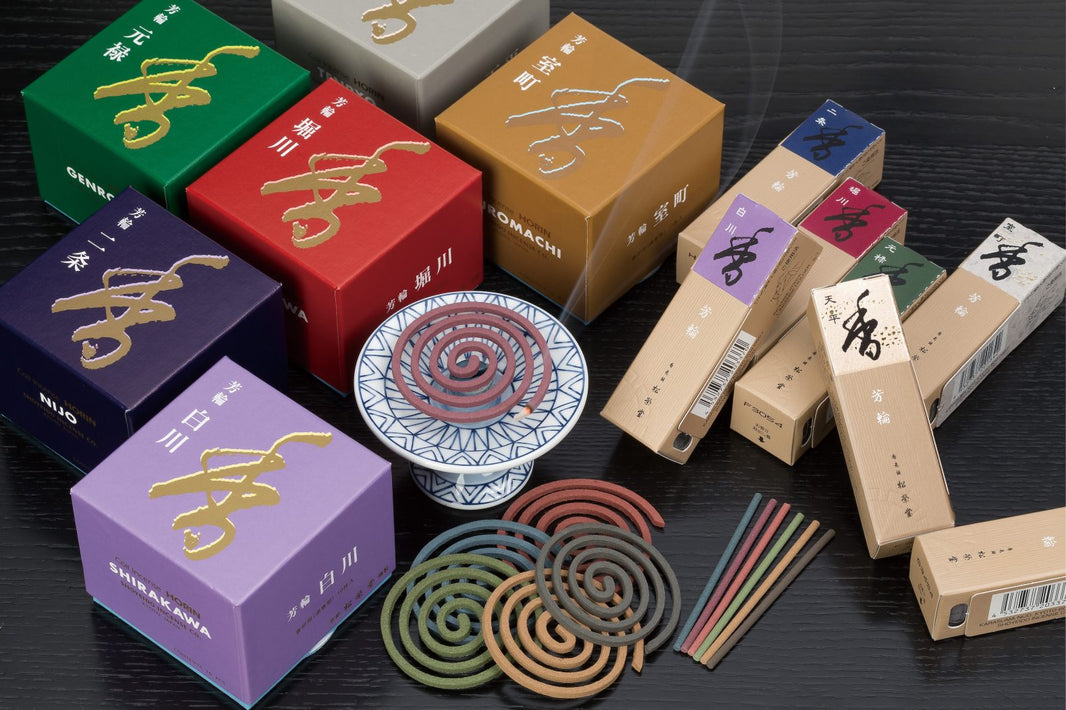
- Sandalwood (byakudan). Creamy, soft, milky and warm. The easiest place to start, and the backbone of most Japanese blends.
- Agarwood (jinkō). Resinous, deep and often described as temple like. Quieter at first than sandalwood, then longer lasting.
- Kyara. The rarest and most refined grade of agarwood, with a bittersweet complexity that no other material has. Priced accordingly.
- Floral. Plum, rose, osmanthus, lotus and more. Bright, approachable and popular as a first purchase.
- Earthy and herbal. Traditional temple blends with spices and medicinal herbs. Dry, grounded and slightly bitter.
- Fruity, sweet, watery and musk. Modern everyday scents, usually lighter in smoke and easy to live with.
- Frankincense and resin. Warm, balsamic and familiar to anyone who knows church incense.
- Unscented. Used as a base, for practice, and in incense appreciation.
6. From light to rich
You do not need to find the perfect incense on the first try, and we would rather you did not spend a lot of money attempting it.
Think of our range as a single line running from light to rich. A sandalwood blend at an everyday price sits in the middle of that line, and it is where we suggest most people start. If it feels too light or too thin, move toward agarwood or toward a higher grade of the same blend. If it feels too heavy or too smoky, move toward a floral or a milder sandalwood. Each step teaches you more about your own taste than a description ever will.
If you tell us what you have tried and what you liked or disliked about it, we will suggest the next step. This is the most useful thing we can do for you, and we are happy to do it.
7. Forms and burning times
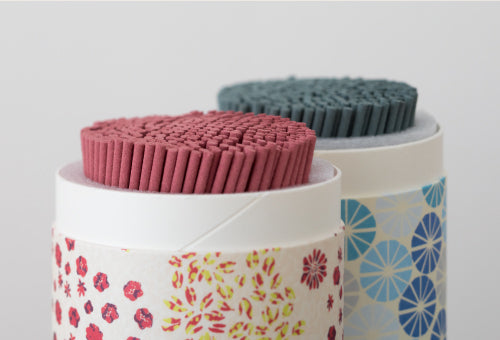
- Sticks. The most common form. Most burn for 10 to 30 minutes, and you can break a stick to shorten it.
- Coils. Burn slowly for one to two hours or longer. Good for a long evening or a large room.
- Cones. Short and more concentrated, with a stronger burst of scent.
- Kneaded incense (nerikō). Warmed on ash rather than burned, in the traditional way.
- Pressed incense (inkō), powdered incense (zukō) and incense wood. Used in incense appreciation and in tea ceremony.
- Sachets. No burning at all. For a drawer, a wardrobe or a bag.
Sticks and cones need something to hold them and to catch the ash. We carry incense holders for everyday use and incense burners for ash based burning.
8. Not sure where to start? Try a sampler
With a range this size, buying a full box of something you have never smelled is a gamble. Our samplers contain small quantities of several scents so that you can find your direction first, and our assortments and gift sets work the same way. Most customers who write to us for advice end up here, and we think it is the right first order.
9. Six steps from cart to checkout
Step 1. Choose your items. Browse by scent, by form or by maker. Sections 4 to 8 above will help you narrow things down.
Step 2. Add to cart. Before you do, check the dispatch time shown on the product page. See section 1.
Step 3. Go to checkout. We accept Visa, Mastercard, American Express, JCB and Discover, as well as PayPal, Shop Pay, Apple Pay and Google Pay. Where your country is supported, prices are shown in your local currency.
Step 4. Enter your details. Please write your address in Roman letters, and include a phone number, as some carriers require one for delivery. Once your address is entered, the shipping options available for your country appear with their fees and estimated delivery times. Please also read section 2 about duties before you continue.
Step 5. Review and place your order. Check your items, your address and the shipping method you selected, then place the order. You will receive a confirmation email. If it does not arrive, please check your spam or junk folder before contacting us.
Step 6. Dispatch and tracking. When your parcel leaves us, we send a shipping confirmation email with your tracking number. See section 3 for what to expect from tracking, and section 10 if something looks wrong.
10. Tracking your parcel
Your tracking number arrives by email when your parcel is dispatched, and you can also find it in your account. Tracking can be slow to start and can pause for several days at a time, especially during customs clearance. If your parcel has not moved for a long time, or if tracking says delivered and you have not received it, our FAQ explains what to check first, and you can write to us at any point.
11. Changes, cancellations and refunds
If you need to change an address or cancel, please contact us as soon as you can, and before your parcel is dispatched. For sourced items the useful deadline is earlier than the dispatch date, because we place orders with our makers in batches. Cancelling part of an order is possible as well. Refunds go back to the payment method you used, normally within 3 to 5 business days of us confirming them. Full details are in our FAQ.
12. If customs charges you
If the postal service or the courier asks you for import charges, that request comes from them and from your customs authority, not from us. Before you pay, you are entitled to ask them to confirm how the amount was calculated, and it is worth doing if the figure looks wrong to you. If you would like us to look at the paperwork with you, send it to us and we will help as far as we can.
13. If an item is discontinued
Japanese incense makers discontinue products regularly, sometimes without notice, and a sourced item can turn out to be unavailable after you have ordered it. If that happens we will email you, suggest the closest alternative we can find, and refund that item if you would rather not take a substitute. Our advice on alternatives is free, and we would rather find you something you will enjoy than simply cancel.
14. How to burn incense
If you are new to Japanese incense, our Beginner's Guide to Japanese Incense walks through lighting, holders, burning times and the differences between the forms.
Briefly: light the tip of the stick, let it catch, then put the flame out and let the ember glow. Stand the stick in a holder placed on a plate or in a burner filled with ash, and let the scent come to you rather than leaning into it. Burn incense in a ventilated room, and never leave it unattended.
15. Ash, burners and holders
A simple holder on a small plate is enough to begin with, and needs no maintenance beyond brushing the ash away. If you use an ash filled burner, keep the ash dry, loosen it occasionally so that air can move through it, and top it up as it is consumed. Ceramic burners and holders can be wiped clean with a dry cloth.
16. Storage and safety
Keep incense in its box, away from direct sunlight, heat and humidity, and away from strong smelling things, as it will pick up their scent. Kept this way, most incense stays in good condition for years, and some traditional blends are considered to improve.
Always burn incense on a heat resistant surface, in a ventilated room, away from curtains and anything else that can catch fire, and out of reach of children and pets. Never leave burning incense unattended.
17. Gifts
You can have an order sent straight to someone else by entering their address as the shipping address at checkout. Please use your own details for the billing address so that we know who the order is from.
We do not put any document showing prices inside the parcel. The only paper we include is our shop card. Please note, however, that the customs declaration attached to the outside of the parcel does show the value of the contents, because customs authorities require it. That applies to every international parcel and we are not able to leave it off.
We do not offer a gift wrapping service. Many of our gift sets and assortments come in the maker's own presentation box, which is made to be given as it is, so they are the easiest choice if you would like something that arrives looking finished.
Please also read section 2 before sending a gift abroad. Outside the United States, import charges are billed to the person who receives the parcel, so if you would rather your recipient was not asked for money, the safest approach is to have the order delivered to yourself first and to forward it. We are not able to mark an order as a gift for customs purposes.
18. Saved Items
The heart icon on a product saves it to your Saved Items list.
If you are signed in to your account, your list is stored with your account, so it stays with you when you switch to another device or another browser. If you are not signed in, your list is stored in that browser only, which means it can be lost if your browser clears its storage, and it will not appear on your other devices. Creating an account, or signing in before you start saving, is the way to keep a list safely. There is also a Copy link button, which gives you a link to your current list that you can open anywhere.
19. Contacting us
Email us at info@wa-no-kaori-incense.com. We reply within 2 business days, and usually sooner.
One request. Our replies are sometimes filtered into spam or junk folders, and we have had customers wait for an answer that had already been sent. If you have written to us and heard nothing, please check that folder, and adding our address to your contacts will help future messages reach you.